Ships, parts and seminars
The Galactic Exchange has four tabs and only the first is a share market. The other three sell things.
They share one skeleton: each faction lists stock once an hour, a lot sits for six hours, unsold lots are withdrawn, and nothing exists until you pay. An offer is a row in a list; the item is created at purchase. Only the goods differ.
All three are reachable without leaving the Exchange screen, and all three are gated on what factions think of you.
Decommissioned hulls
Section titled “Decommissioned hulls”Factions retire ships. This is where the hulls go.
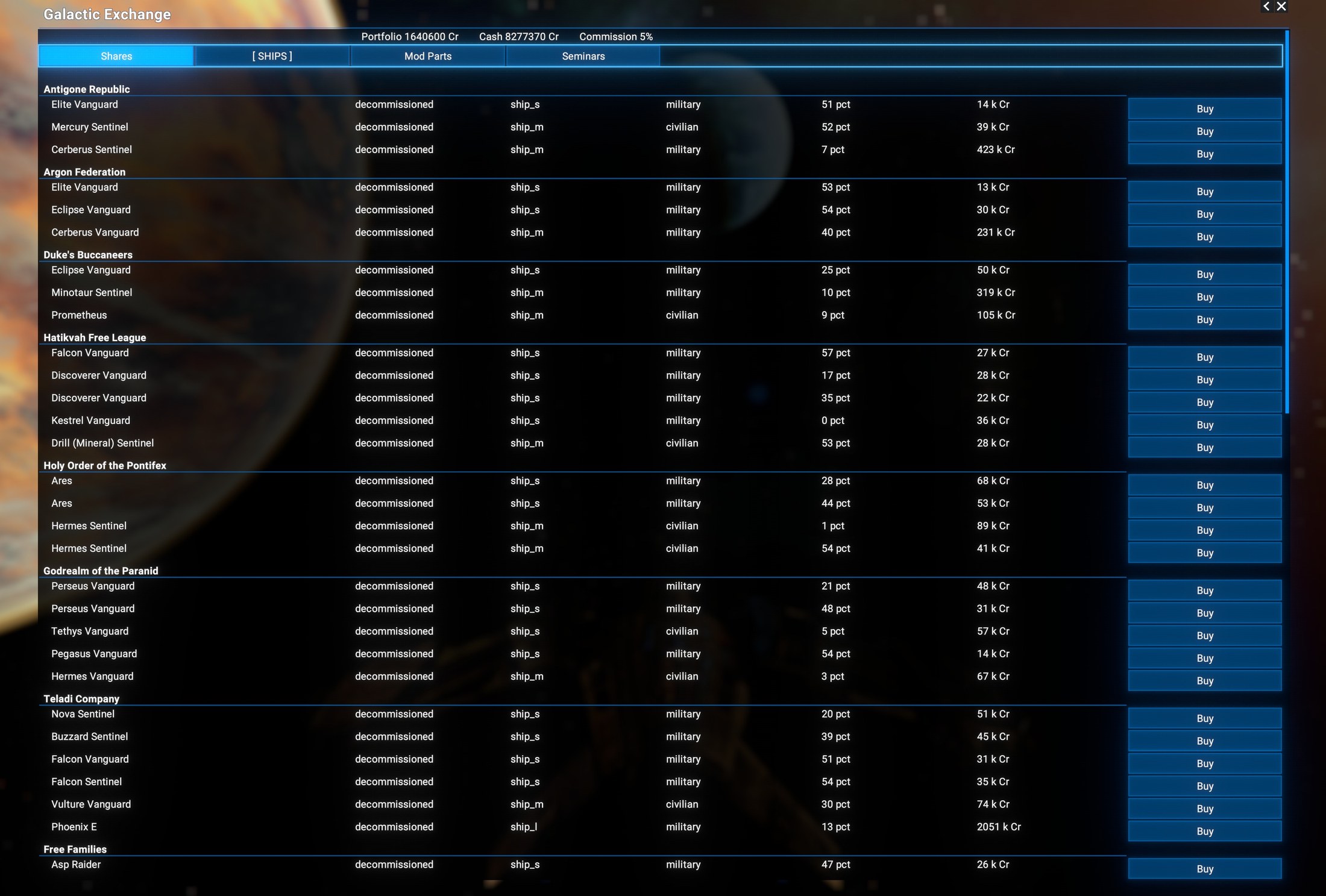
Who offers what
Section titled “Who offers what”| Knob | Default | Meaning |
|---|---|---|
| Civilian hulls from relation | 10 | Traders, miners, transports |
| Military hulls from relation | 20 | Anything armed |
| Small hulls, at most | 4 | per faction, per hour |
| Medium hulls, at most | 2 | per faction, per hour |
| Large hull chance | 50% | at most one, when it rolls |
| Very large hull chance | 10% | at most one, when it rolls |
The shape of that table is the design: small hulls are stock, large hulls are an event. A faction you are merely tolerated by will show you freighters; a faction that likes you will occasionally put a destroyer on the board.
The price is the damage
Section titled “The price is the damage”Price falls out of two multiplications, not a table:
price = average ware price × (100 − decommission discount) × (100 − hull damage)
| Knob | Default |
|---|---|
| Decommission discount | 60% |
| Worst hull damage | 60% |
| Damage discount weight | 100% |
| Offer shelf life | 6 h |
At the defaults an undamaged hull costs 40% of its ware price, and the worst hull on the board — 60% damaged — costs 16%. That is the whole spread, and the damage column on screen is therefore also the price column: the Kestrel Vanguard above at 0% costs more than the Elite Vanguard at 51% despite being the same class.
Damage weight is the knob that decides whether wrecks are bargains. At 100% damage counts in full; at 0 a battered hull costs the same as a fresh one and the percentage becomes decoration.
What never appears
Section titled “What never appears”Candidates are sampled from ships actually flying in your galaxy, not read from a list of macros. Three consequences fall out of that, all of them wanted:
- A ship from a DLC you do not own cannot be offered, because it is not out there to sample.
- Rarity is inherited from the galaxy. An Asgard is rare in the market because an Asgard is rare in space.
- A hull with no priced ware produces no offer — which quietly keeps story and unique ships off the market without anybody having to name them.
Xenon trophies
Section titled “Xenon trophies”The same tab carries prizes taken from the Xenon, and they deliberately break every rule above.
| Ordinary hull | Xenon trophy | |
|---|---|---|
| Condition | damaged, priced down | sold whole |
| Discount | 60% decommission | none |
| Equipment | stripped to a bare hull | full weapons and shields |
| Needs relation | 10 civilian / 20 military | 20 |
| How many | up to 4 S and 2 M each hour | at most one, on a chance roll |
| Chance by class | L 50%, XL 10% | S 25%, M 10%, L 2% |
A trophy is cheaper than it sounds, because a ship ware’s price covers the hull only — so the Xenon gear on top is effectively free. That is intended: a trophy should feel like a prize somebody else won and cashed in, not a fair transaction.
Equipment mods
Section titled “Equipment mods”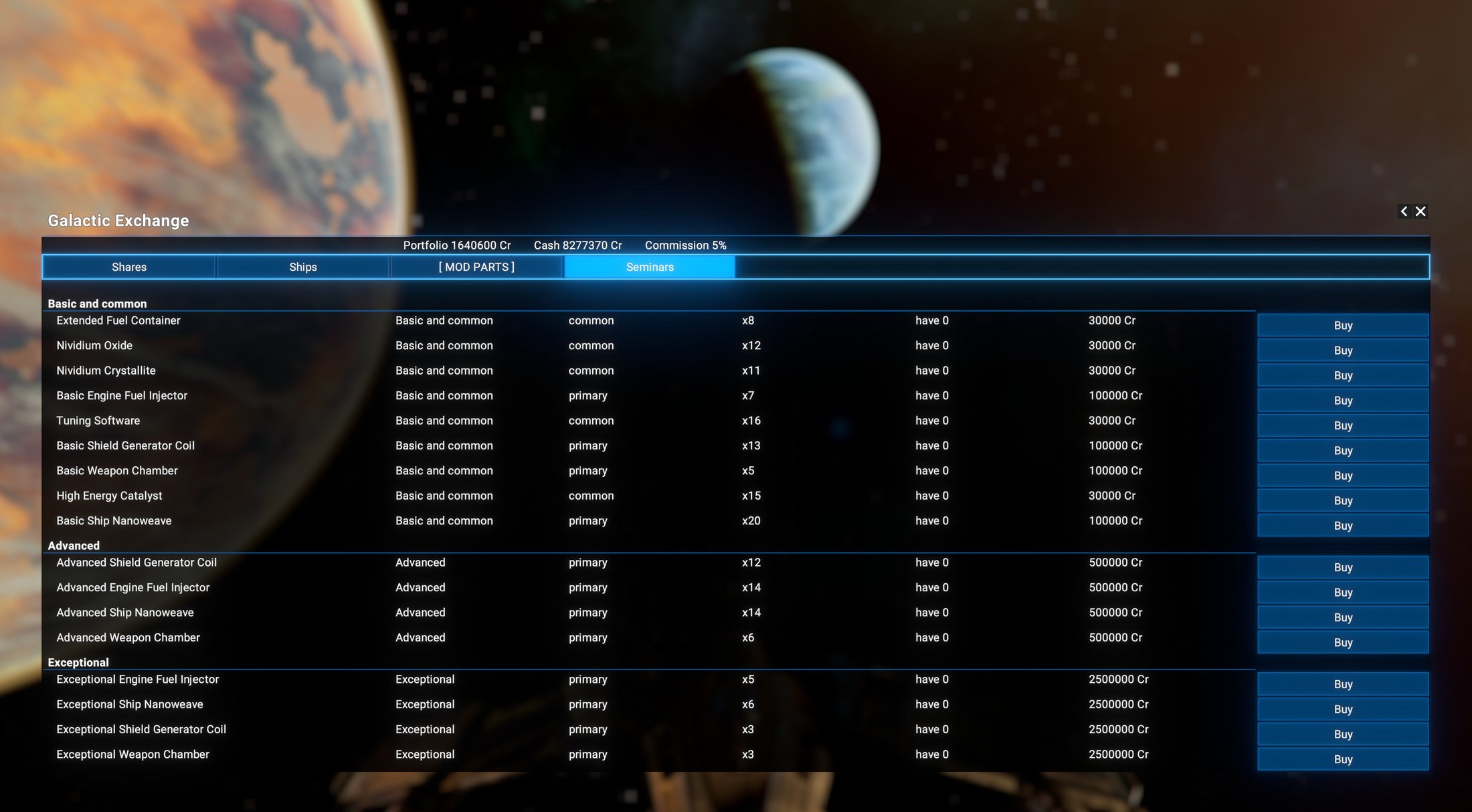
| Knob | Default | Knob | Default | |
|---|---|---|---|---|
| Basic and common, at least / at most | 5 / 10 | Primary part price | 200% of the mod | |
| Advanced, at least / at most | 2 / 5 | Common part price | 60% of the mod | |
| Exceptional, at least / at most | 1 / 2 | Part shelf life | 6 h |
The catalogue is asked for, not listed: the mod queries the game’s own ware database for everything flagged as an equipment mod and reads each one’s quality tier from the ware itself. Naming the parts in script would have been dozens of chances to reference a ware from a DLC the player does not own — which in X4 is a load-time rejection that drops the whole library silently.
That tier is then cross-checked against a second source. The game’s own wares.xml says mk1 ×43 at 50 000 Cr, mk2 ×26 at 250 000 Cr, mk3 ×15 at 1 250 000 Cr. If the roll produces three buckets of those sizes at those prices, quality 1/2/3 = basic/advanced/exceptional is confirmed by two sources that cannot both be wrong the same way. The prices on screen are that arithmetic: 50 000 × 200% = 100 000, 250 000 × 200% = 500 000, 1 250 000 × 200% = 2 500 000.
Who sells
Section titled “Who sells”Every claimspace faction except the Xenon, the Kha’ak and the pirates — and “pirate” is the engine’s own tag rather than a list the mod keeps. Follow that honestly and it produces two results worth knowing:
- The Hatikvah Free League do not sell, because vanilla tags them
pirate plunder. - The Riptide Rakers do, because they are tagged
scavengerand not pirate.
Both are the game’s opinion, not the mod’s, and the seller list is logged on every roll so the disagreement stays visible instead of looking like a bug.
This rule is the mod-part market’s alone. The hulls tab gates on relation only — which is why the Hatikvah and the Duke’s Buccaneers both appear in the ships screenshot above and neither of them sells you a single part.
Offers are aggregated by ware rather than by seller here, unlike the ships tab — a page of identical Tuning Software rows from eleven factions is a worse screen than one row with a count.
Crew seminars
Section titled “Crew seminars”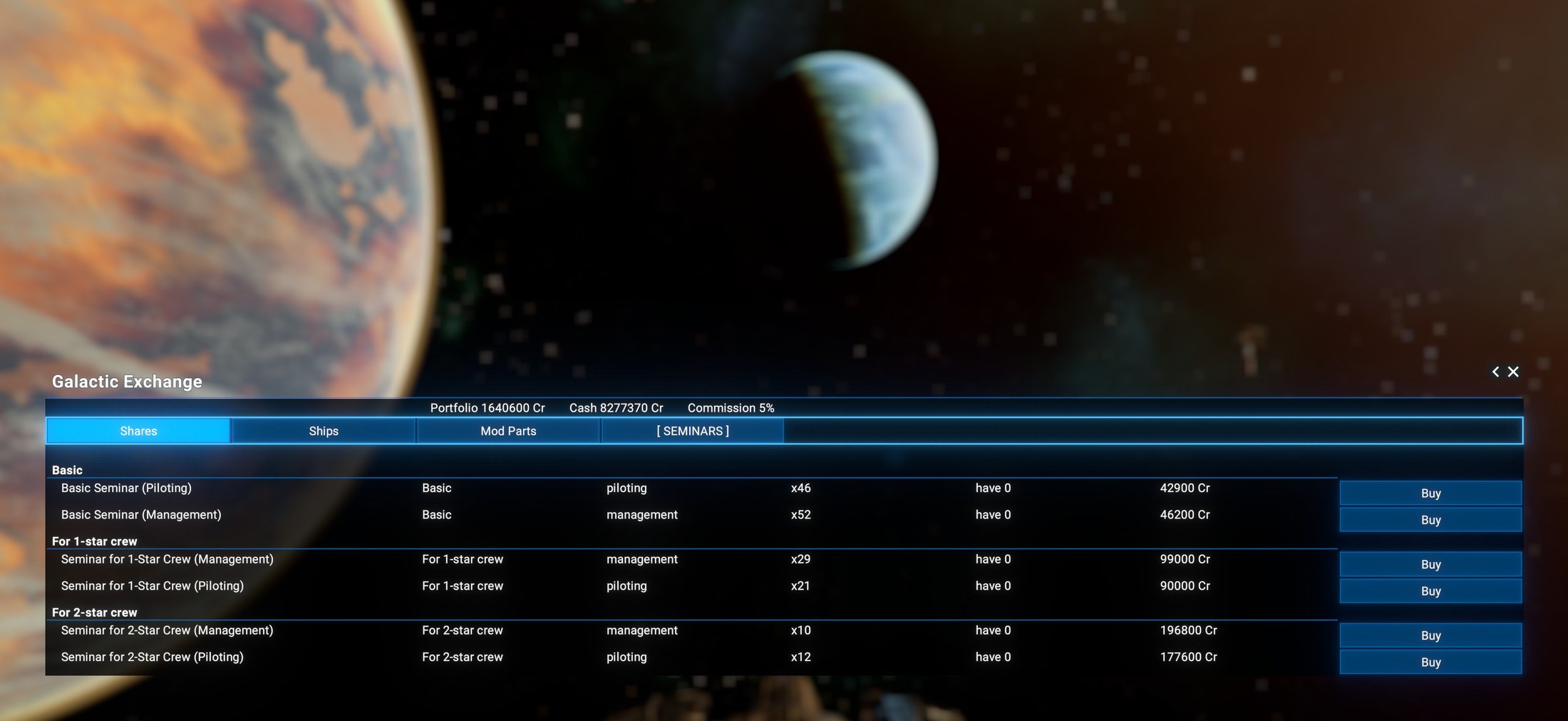
Six wares: management and piloting, first three levels only.
| Knob | Default | Knob | Default | |
|---|---|---|---|---|
| Basic, at least / at most | 5 / 10 | Seminar price | 1000% of shop | |
| 1-star, at least / at most | 2 / 5 | Seminar shelf life | 6 h | |
| 2-star, at least / at most | 1 / 2 |
That multiplier is not a typo and it is the whole model. It started at 200% — “twice the shop price” — and was raised fivefold, because at 200% seminars were simply better bought here than found, and the market replaced the gameplay it was meant to garnish.
| Seminar | Shop | Exchange |
|---|---|---|
| Basic (management) | 4 620 | 46 200 |
| Basic (piloting) | 4 290 | 42 900 |
| 1-star (management) | 9 900 | 99 000 |
| 1-star (piloting) | 9 000 | 90 000 |
| 2-star (management) | 19 680 | 196 800 |
| 2-star (piloting) | 17 760 | 177 600 |
Like the mod parts, what counts as a seminar is asked, not listed — the mod queries wares tagged seminar and takes the level from the ware’s own level tags. The deprecated gift-inventory seminars are excluded without being named, because they do not carry that tag; and if a DLC ever adds a third trainable skill, it appears here with no code change.
Turning them off
Section titled “Turning them off”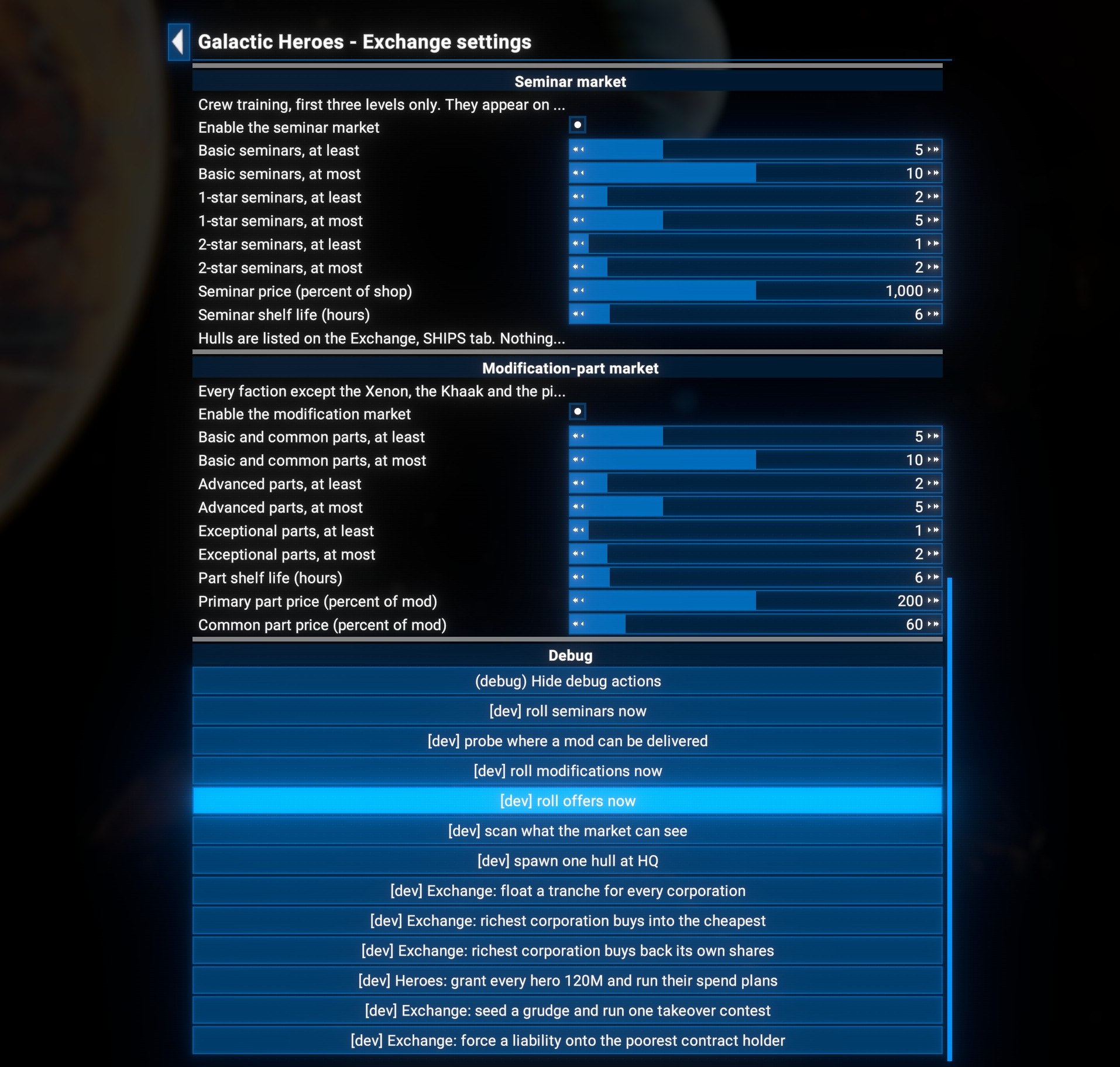
Each market has its own master switch — Enable the surplus market, Enable the modification market, Enable the seminar market — and each is independent of the share market and of the others. Turning one off stops its offers; it does not disable the Exchange screen or the tab.
The [dev] row underneath is the answer to a real problem: stock rolls once an hour and a lot lives six hours, so a short test session would see one roll and conclude the market was empty. [dev] roll offers now runs the same code path the hourly timer runs — not a shortcut around it — which is what makes a five-minute check meaningful.
Honest list
Section titled “Honest list”- Hull sampling depends on traffic. A quiet galaxy or an early save offers fewer candidates, so an empty-looking ships tab in the first hour is normal rather than broken.
- Delivery differs by good. Seminars carry the inventory tag and go straight to you; assembled equipment mods do not, and the purchase reads the inventory back before charging so a silent delivery failure becomes a visible one.
- Commission applies here too. The 5% on the status row is charged on these tabs as well as on shares.
- Trophy supply is not modelled. A trophy appears on a chance roll for a faction at +20; nothing checks that the faction actually fought the Xenon for it.
- Prices ignore your reputation past the gate. Relation decides whether a faction offers you something, not what it charges. A friendlier faction shows you more, not cheaper.