Corporations
A faction fights wars and builds stations. A corporation does neither. It is a supra-faction investment fund: it finances the people who fight and build, manages stations it does not own, insures cargo it never carries, and books the difference.
Seventeen of them ship. They are not a faction reskin — they hold no territory, fly no ships of their own, and have no relation value with the player. What they have is capital, favour with each faction, and a grudge list.
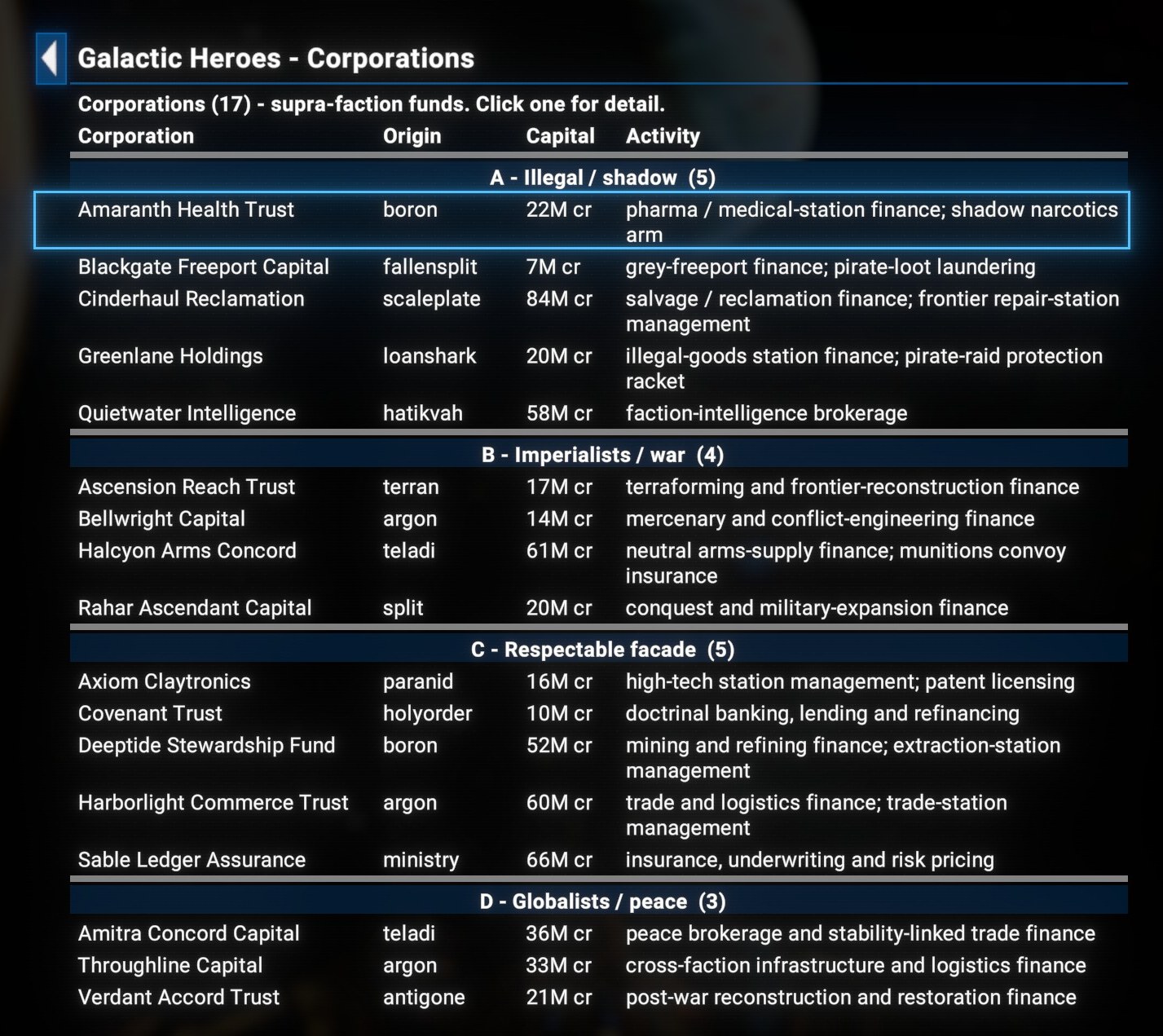
The four buckets
Section titled “The four buckets”Every corporation sits in one of four buckets. The bucket is not a faction alignment — it is how the company presents itself versus how it makes money.
| Bucket | Count | What it means |
|---|---|---|
| A — Illegal / shadow | 5 | Openly criminal finance, or a legal business whose margin comes from an illegal arm. |
| B — Imperialists / war | 4 | Profits from conflict. Some engineer it; all of them prefer the war to continue. |
| C — Respectable facade | 5 | Spotless public record. The methods are in the footnotes. |
| D — Globalists / peace | 3 | Genuinely builds, rebuilds and brokers peace — and writes the dependency into the contract. |
The roster
Section titled “The roster”Each company has an origin faction (where its money and its politics come from), a field (the business it is in), and a competitive MO — the thing it does that does not appear in its prospectus. The MO is not flavour text: it is what the company’s planning cycle actually does when it has capital to spend.
A — Illegal / shadow
Section titled “A — Illegal / shadow”| Corporation | Origin | Field | Competitive MO |
|---|---|---|---|
| Amaranth Health Trust | boron | pharma / medical-station finance; shadow narcotics arm | public healer, private narcotics financier; bribes for uninspected convoys |
| Blackgate Freeport Capital | fallensplit | grey-freeport finance; pirate-loot laundering | launders pirate loot into faction supply; bribes customs |
| Cinderhaul Reclamation | scaleplate | salvage / reclamation finance; frontier repair-station management | finances raiders to make the wrecks it reclaims |
| Greenlane Holdings | loanshark | illegal-goods station finance; pirate-raid protection racket | pays pirates not to raid clients, funds those that raid rivals |
| Quietwater Intelligence | hatikvah | faction-intelligence brokerage | sells the same secret to rivals and profits from the conflict it seeds |
B — Imperialists / war
Section titled “B — Imperialists / war”| Corporation | Origin | Field | Competitive MO |
|---|---|---|---|
| Ascension Reach Trust | terran | terraforming and frontier-reconstruction finance | makes rebuilt worlds dependent on its origin faction |
| Bellwright Capital | argon | mercenary and conflict-engineering finance | finances raiders to trigger wars, then finances the reconstruction |
| Halcyon Arms Concord | teladi | neutral arms-supply finance; munitions convoy insurance | funds both sides and bribes to keep conflicts simmering |
| Rahar Ascendant Capital | split | conquest and military-expansion finance | bankrolls invasions to open markets by force |
C — Respectable facade
Section titled “C — Respectable facade”| Corporation | Origin | Field | Competitive MO |
|---|---|---|---|
| Axiom Claytronics | paranid | high-tech station management; patent licensing | share-raiding and regulatory capture via bribed sanctions |
| Covenant Trust | holyorder | doctrinal banking, lending and refinancing | sacred-charity facade over usurious, coercive lending |
| Deeptide Stewardship Fund | boron | mining and refining finance; extraction-station management | ecological-stewardship veneer over strip-mining |
| Harborlight Commerce Trust | argon | trade and logistics finance; trade-station management | buys sanctions to strangle a competitor’s logistics |
| Sable Ledger Assurance | ministry | insurance, underwriting and risk pricing | moral hazard: funds the raiders whose attacks raise its premiums |
D — Globalists / peace
Section titled “D — Globalists / peace”| Corporation | Origin | Field | Competitive MO |
|---|---|---|---|
| Amitra Concord Capital | teladi | peace brokerage and stability-linked trade finance | manufactures dependency through aid; undercuts war-profiteers |
| Throughline Capital | argon | cross-faction infrastructure and logistics finance | locks clients into dependency and starves protectionist rivals |
| Verdant Accord Trust | antigone | post-war reconstruction and restoration finance | ties reconstruction aid to long-term management contracts |
The dossier
Section titled “The dossier”Click any row and you get the company’s file. It is the same file the mod’s own planner reads.
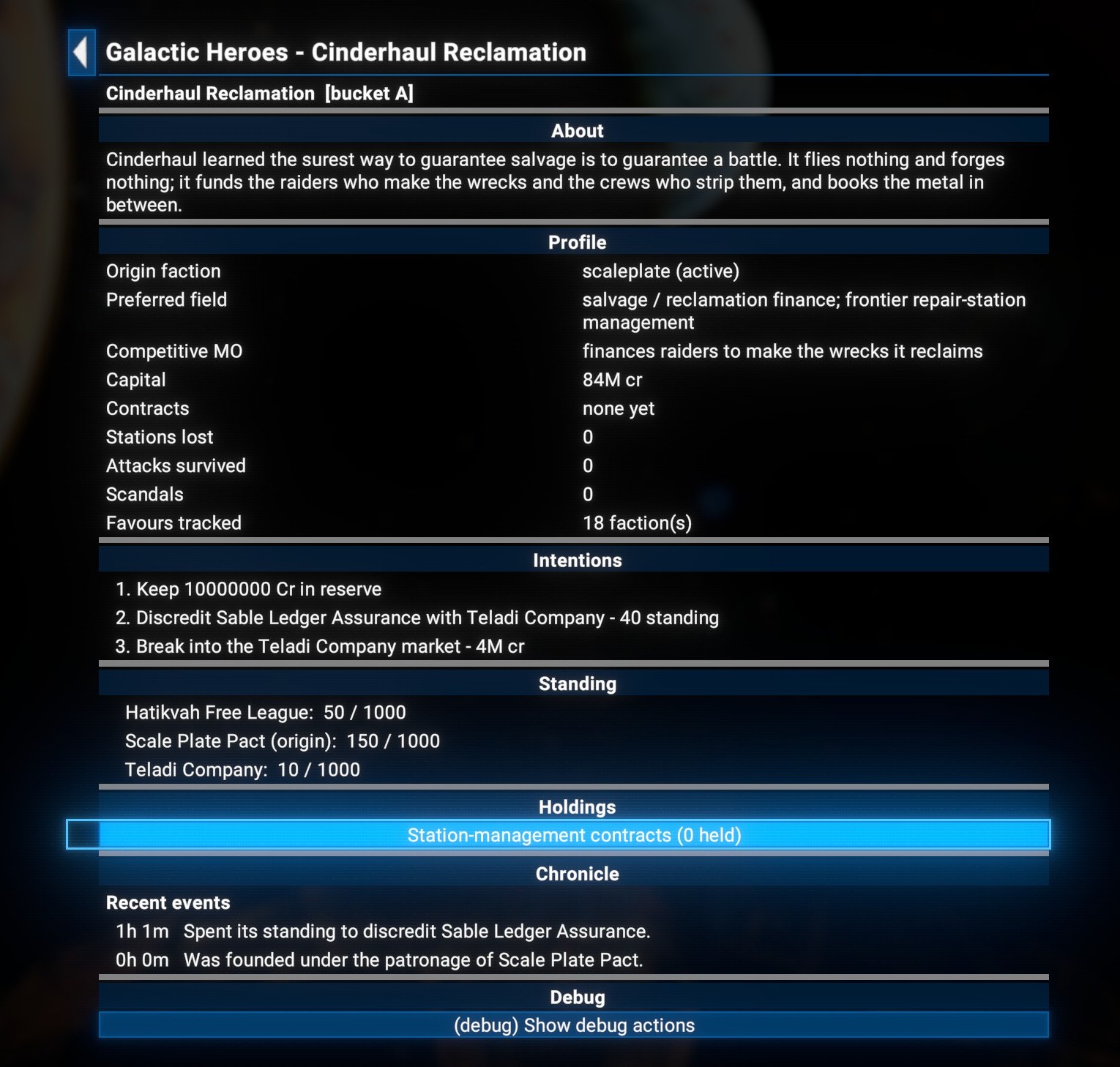
Intentions is the part worth watching. Every planning cycle the company writes down what it intends to buy with the capital it has free, in priority order, and how much it has set aside for each. Reading two dossiers side by side tells you which markets are about to be contested.
This one is a small story on its own. Cinderhaul holds 150 favour at home and 10 with the Teladi — and its second intention is to spend 40 of its Teladi standing discrediting Sable Ledger Assurance, an insurer that funds raiders for the same reason Cinderhaul does. Its third intention is to break into that same Teladi market. It is attacking a rival’s reputation in the market it wants, before it bids there. The chronicle two blocks down already records it doing so.
The Holdings row is the reality check against all that ambition: station-management contracts, 0 held.
Favour — the currency of corporate politics
Section titled “Favour — the currency of corporate politics”A corporation holds favour with each faction separately, on a 0–1000 scale. Favour is not the player’s reputation and not the faction relation: it is how much political weight the company can spend inside that faction’s administration.
It is spent to bid for station-management contracts and to run political operations, and its capacity is finite — so a company buying its way into three markets at once is weak in all three. A corporation with money and no favour can do nothing. That is the intended shape: the constraint on a fund is political access, not cash.
There are two ways to get it, and they say different things about a company.
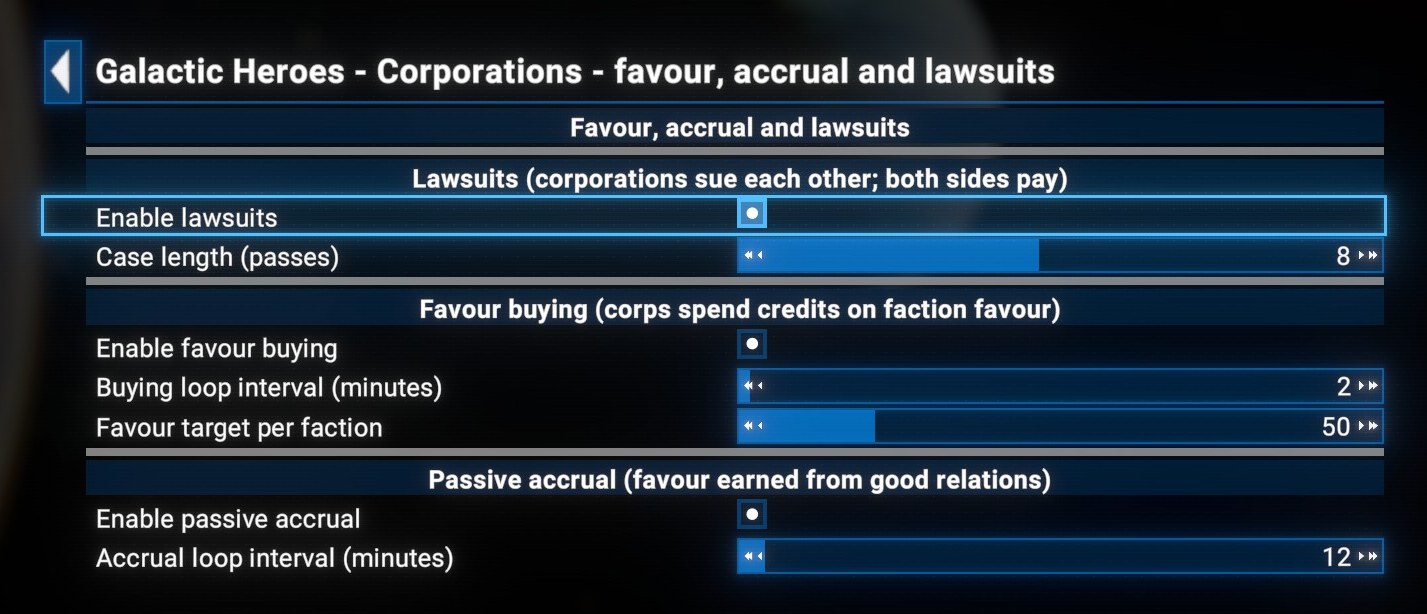
| Route | Costs | Loop | Meaning |
|---|---|---|---|
| Passive accrual | nothing | every 12 min | Favour earned from good relations. Slow, free, and a company with none is a company nobody likes. |
| Favour buying | credits | every 2 min | The company spends cash on access, up to a target per faction (50 by default). |
That the buying loop runs six times more often than the free one is the balance of the whole layer in two numbers: a rich company can buy political access far faster than a liked one earns it. The target caps how far money alone gets you — past it, buying stops and only relations move the needle.
Cut favour target per faction to 0 and corporations can only earn favour; they will bid rarely, and the roster’s rich and poor stop separating. Raise it and the buckets with the biggest treasuries take everything.
Lawsuits
Section titled “Lawsuits”Corporations sue each other, and both sides pay.
Two cases are filed per planning pass, and each runs for a fixed number of passes — 8 by default, adjustable from 1 to 16. For the whole of that time both companies carry the cost as an obligation, not a fee. That distinction is the mechanic: an obligation cannot be stopped halfway and is not scaled to what either side can afford, which is exactly why a lawsuit is the kind of thing that can bankrupt a company and a bad trade is not.
There is no version of a suit that is free for the winner. That is what stops litigation from becoming the dominant strategy.
The pairing is random. A case is filed between two active, solvent companies picked at random — not between two companies with a reason. So the litigation on your galaxy’s docket is a background tax on the whole roster rather than a story about anybody, and reading a company’s chronicle will not tell you why it is being sued. Grudge-driven suits are the obvious next step and are not built.
Station-management contracts
Section titled “Station-management contracts”The visible economic output of the whole layer. A faction tenders the management of one of its stations; corporations bid; the winner manages the station for a fixed term and is paid for keeping it healthy.
| Knob | Default | Notes |
|---|---|---|
| Auction loop interval | 10 min | 2 min on a debug build |
| Base contract cost | 50 favour | the price of one fresh contract |
| Maximum bid | 1000 favour | ceiling on a single offer |
| Reward on a clean period | 200 000 cr + 50 favour | paid per term survived without incident |
| Reward per production module | 50 000 cr | bigger station, bigger fee |
| Penalty when a managed station is destroyed | 200 favour | the manager carries the loss |
Bidding strategy is where the buckets stop being decoration. A corporation commits a share of the favour it holds with the tendering faction, and the share says how much it wants that market:
| Relationship to the tendering faction | Share of held favour committed |
|---|---|
| Its own origin faction | 100% |
| An allied faction | 85% |
| A neutral faction | 60% |
Those three numbers were not chosen by taste. They were set to 100/100/100 as a diagnostic to answer one question — does the share multiplier decide the auction? It does: allied bids went from 0 of 201 awards to 45 of 134. Equal shares also delete the idea the share exists to express, so the shipped values are 100/85/60.
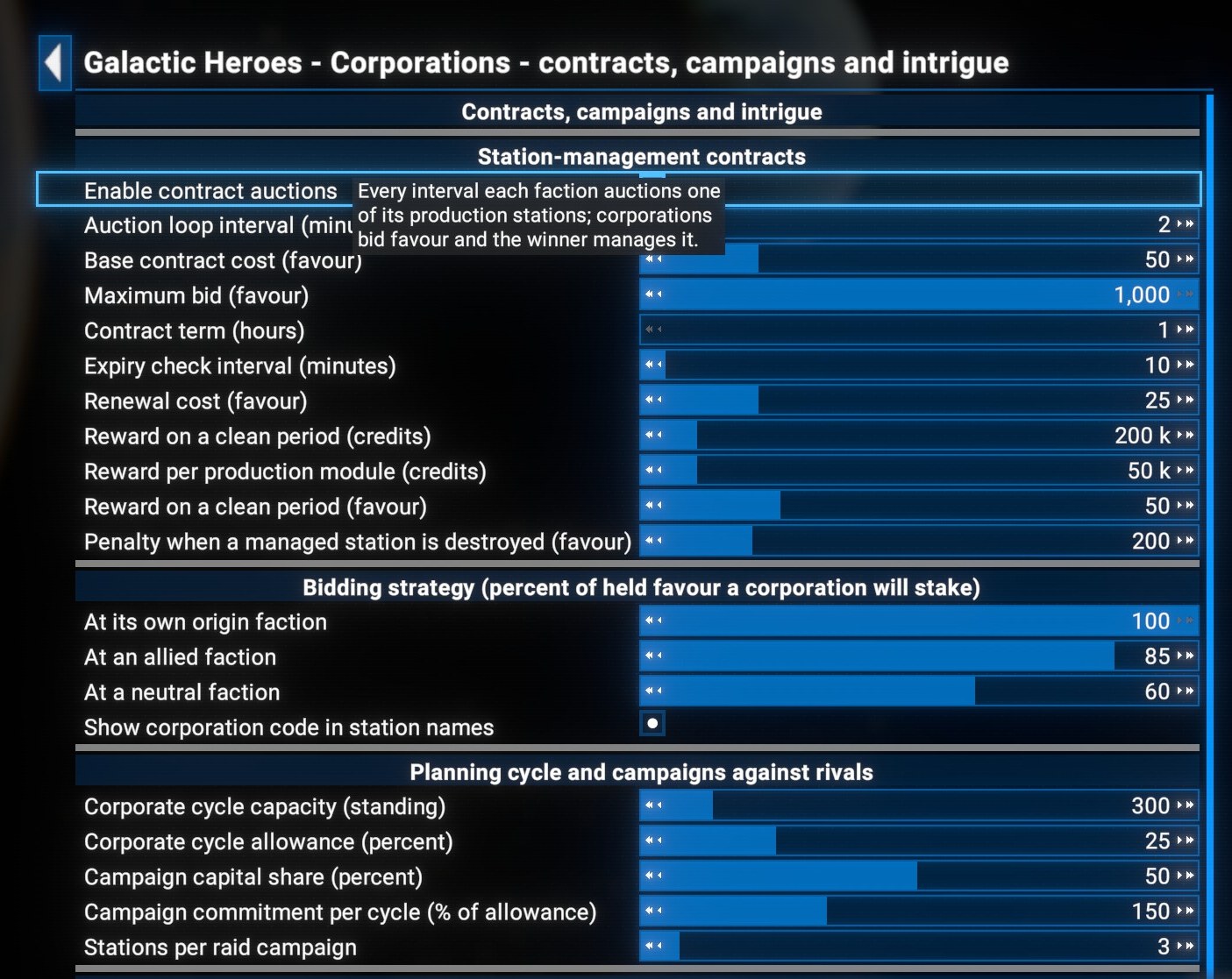
Every number above is a setting, not a literal — the whole layer is tuned from the Settings menu, and the mod’s own driver reads the same values you see there.
Campaigns — how a corporation hurts a rival
Section titled “Campaigns — how a corporation hurts a rival”A company that wants a market held by someone else does not buy it. It makes the incumbent’s holding expensive.
Raids and assaults. The corporation posts a job on a pirate faction’s board and hires a Pirate Raider hero to hit a rival-managed station. It pays a fee plus instalments over several passes. This is a real hero flying a real ship: he can arrive and succeed, break off at a hull threshold, be killed on the job, or never arrive at all. Each outcome is recorded, and the instalments are owed or released accordingly.
A corporation can only hire a raider it has at least 30 favour with. A war chest with no underworld access buys nothing.
Intrigue. Cheaper, slower, no ships involved. The corporation spends its standing with a faction rather than credits:
- Scandal — the faction fines the rival over its contracts there.
- Discredit — the rival’s reputation takes the damage instead of its treasury.
Both cost the instigator standing with the faction it used, so a company cannot run intrigue forever on one government.
Debt, liabilities and liquidation
Section titled “Debt, liabilities and liquidation”A corporation’s capital is not a score. It is spent on favour, bids, campaign instalments and the obligations it has taken on.
- An obligation — a raid instalment, a settled liability — is the only thing that can drive a company’s balance down far enough to matter. Ordinary friction flattens the field; an obligation concentrates the loss.
- A company that cannot meet its obligations is liquidated: it stops planning, its contracts go on the market, and the event is written into its chronicle.
- A stronger company can instead subordinate a weaker one — see Galactic Exchange. A parent may sweep a subsidiary’s treasury, but the subsidiary keeps a floor: 40% of what it was founded with, by default.
That floor exists because a flat figure did not survive contact with the roster. It used to be a fixed 40 000 000 cr, sized for the 100M host companies; against the 20M Tidewater Mutual it was twice the company’s entire capital, so ten sweeps moved 0 cr up and 58 400 000 cr down. As a percentage of founding capital, a 100M company behaves exactly as before and a 20M one keeps 8M.
Chronicle
Section titled “Chronicle”Everything above leaves a trail. Each corporation carries an append-only chronicle — founding, tenders won and lost, raids ordered and their outcomes, scandals, share movements, liquidation. It is the readable history of a company you never controlled.
What the player does here
Section titled “What the player does here”Nothing is required. The layer runs whether you look at it or not. What you can do:
- Read the board before you invest. Intentions tell you which markets are about to be fought over; the Exchange lets you take a position in the company you think wins.
- Take their work. Corporations at war with each other hire outsiders — see Corporation missions. Both sides of a feud hire, so the job you take this week is remembered by the company you took it against.
- Watch a war you are not in. Two funds contesting one faction’s stations is a slow, legible conflict with no combat in it at all.
Watching it move without waiting
Section titled “Watching it move without waiting”The planning cycle runs every few game-minutes and a contract term is measured in hours, so a short session shows you a still photograph of a layer that is meant to be watched over an evening. The settings page carries a row of dev levers for exactly that.
![Galactic Heroes - Corporations settings with debug actions expanded. Above: Enable corporations, and links to the two settings pages, Contracts, campaigns and intrigue, and Favour, accrual and lawsuits. A Debug block holds "(debug) Hide debug actions" and "[dev] re-plan corporations now", then a "-- dev: driver test --" group of buttons: run one favour decision pass now (all corps), run one passive accrual pass now (all corps), seed gang standing on ALL corps, run one contract auction now (all factions), restore ALL station names (remove corp markers), mature ALL contracts now (payout + renewal), simulate losing a managed station (penalty, no boom), and clear ALL contracts to reset the test bench](/x4-modding-wiki/img/mods/galactic-heroes/settings-corps-dev.jpg)
Each button runs the same code path the timer runs — it is not a shortcut that fakes the outcome. Mature ALL contracts now pays and renews exactly as the expiry check would; simulate losing a managed station applies the favour penalty without destroying anything. Press four of them in sequence and you have compressed an hour of corporate history into a few seconds, which is the only practical way to tell whether a change to the bidding shares did what you meant.
The buttons are hidden behind (debug) Show debug actions and stay hidden per screen, so a normal game never sees them.
Honest list
Section titled “Honest list”- Corporations do not own ships or stations. They manage, finance and insure. The station stays the faction’s.
- The planning cycle is coarse. A pass every few game-minutes, not a live market. It is a strategic layer, not an economic simulator.
- Bid shares are provisional. 100/85/60 is a measured improvement over the diagnostic, not a tuned endpoint. Dedicated tuning is planned once the functionality settles.
- Awards and renewals are throughput, not chronicle events. A contract awarded every cycle would drown the company’s history in bookkeeping, so only the rarer events are written.
- Lawsuits pair at random. Two cases per pass between two solvent companies picked arbitrarily. The cost is real and the motive is not modelled.
- Favour buying outruns earning it six to one. A 2-minute buying loop against a 12-minute accrual loop means capital converts to political access much faster than goodwill does. Deliberate, and the single biggest lever on which bucket wins.
[MISSIONPAID]has never been observed in a soak. The payment path for a completed corporation mission is built and unit-checked but has not yet been seen end-to-end in a long run — it needs a player to take and finish one.